10 Fence Construction Secrets Contractors Don’t Want You to Know (and How Primescape Does Things Differently)
September 8, 2025
A new fence is a big investment. Learn to spot the 10 biggest industry secrets, from hidden costs to poor…
Louisiana's Leading Fence Contractor


Quick Answer: Postmaster steel posts solve the three problems that kill wood fence posts in Louisiana climate: ground-line rot from humidity, ground-line shear from hurricane wind, and slow termite damage at the soil interface. A Postmaster steel post lasts 30 to 50+ years in Louisiana conditions versus 8 to 15 for a pressure-treated wood post in concrete. The price premium is 15 to 25%. The payback is avoiding a second fence install before year 20.
Every Livingston Parish fence we replace started as a hopeful install with wood posts in concrete. Ten or twelve years later, the panels still look fine and the posts are gone. Rotted at the soil line. Shifted out of plumb by clay soil heave. Sheared off during a hurricane gust. The owner ends up paying for the SAME fence twice, once at install and once at year 12.
This is not a wood-fence problem. It is a wood-POST problem. Postmaster steel posts solve it.
This guide is the engineering case we walk every Louisiana homeowner through during the first call. It covers what Postmaster posts actually are, the wind and soil math behind why they outlast wood, what the install cost premium looks like, and when the upgrade pays back fastest.
Planning a fence in Livingston Parish, Denham Springs, or Greater Baton Rouge? Call or text 225-316-2104 to talk to Kip McDonald about your project. Primescape is the Master Halco authorized Postmaster installer in the area.
Three failure modes account for nearly every wood-post replacement in our service area. They compound, which is why Louisiana wood posts die younger than the same posts in drier climates.
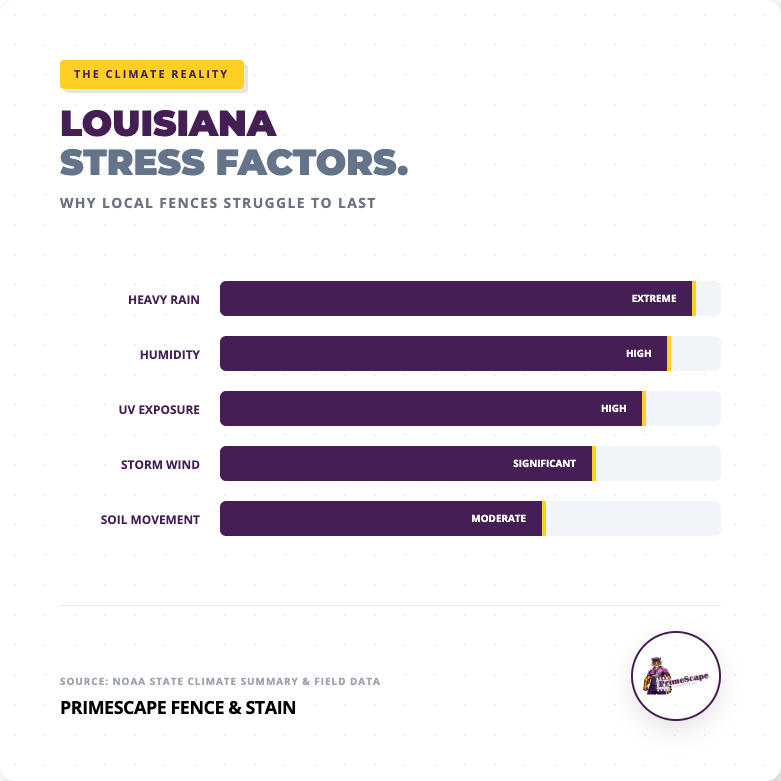
The soil-air interface is where moisture and oxygen and warmth all meet. Pressure-treated wood resists rot longer than untreated, but the treatment chemistry slowly leaches out of the wood. The exact spot where the post emerges from the concrete becomes the rot zone within 8 to 15 years.
This is not about water pooling. It is about a constant 80%+ humidity in the soil-line zone, plus warm Louisiana temperatures that accelerate fungal growth. The National Weather Service New Orleans/Baton Rouge office tracks the heat-and-humidity index data that drives this exposure.
Louisiana clay soils swell and shrink with moisture cycles. A concrete-set wood post in clay sits in a “footing” that itself moves. Over 5 to 10 years, that movement tilts the post or fractures the concrete or both.
The wood post does not break. The geometry around it changes. The fence goes out of plumb, panels start to gap, gates stop closing. The system fails before the wood does.
Louisiana sees real wind every season. Hurricane Ida (2021), Hurricane Francine (2024), and countless tropical storms have peeled fences off properties across the Baton Rouge metro and South Louisiana.
A 4×4 wood post set in concrete has a measurable wind-load rating. In Louisiana clay soil with 6-foot privacy panels, that rating is typically 70 to 90 mph sustained wind. Hurricane gusts routinely exceed that. The post sheers at the ground line, panels pull away, and the fence is in the next yard. The IBHS Fortified Home program emphasizes engineered wind-load systems for exactly this reason.
The Louisiana termite problem is real. Formosan subterranean termites and native species both target wood-in-soil contact. Pressure treatment slows them but does not stop them. A wood post is on the menu the moment it touches dirt.
These four failure modes compound. A wood post is fighting rot, soil shift, wind shear, AND termites simultaneously. The first one to win kills the post.
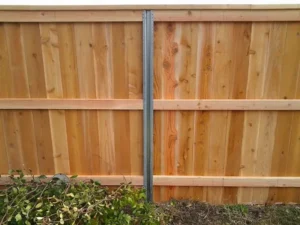
Postmaster is a galvanized steel fence-post system manufactured by Master Halco. The post is 14-gauge structural steel with a hot-dip galvanized coating. The post drives or sets the same way a wood post does (concrete-set, no-dig driven, or other variants). Wood, vinyl, aluminum, or composite panels attach to the steel post via specialized brackets and fasteners.
The result: a fence that LOOKS like a traditional wood (or vinyl, or aluminum) fence but has a steel structural backbone. Visually identical to a homeowner standing in the yard. Structurally a different category from wood-in-concrete.
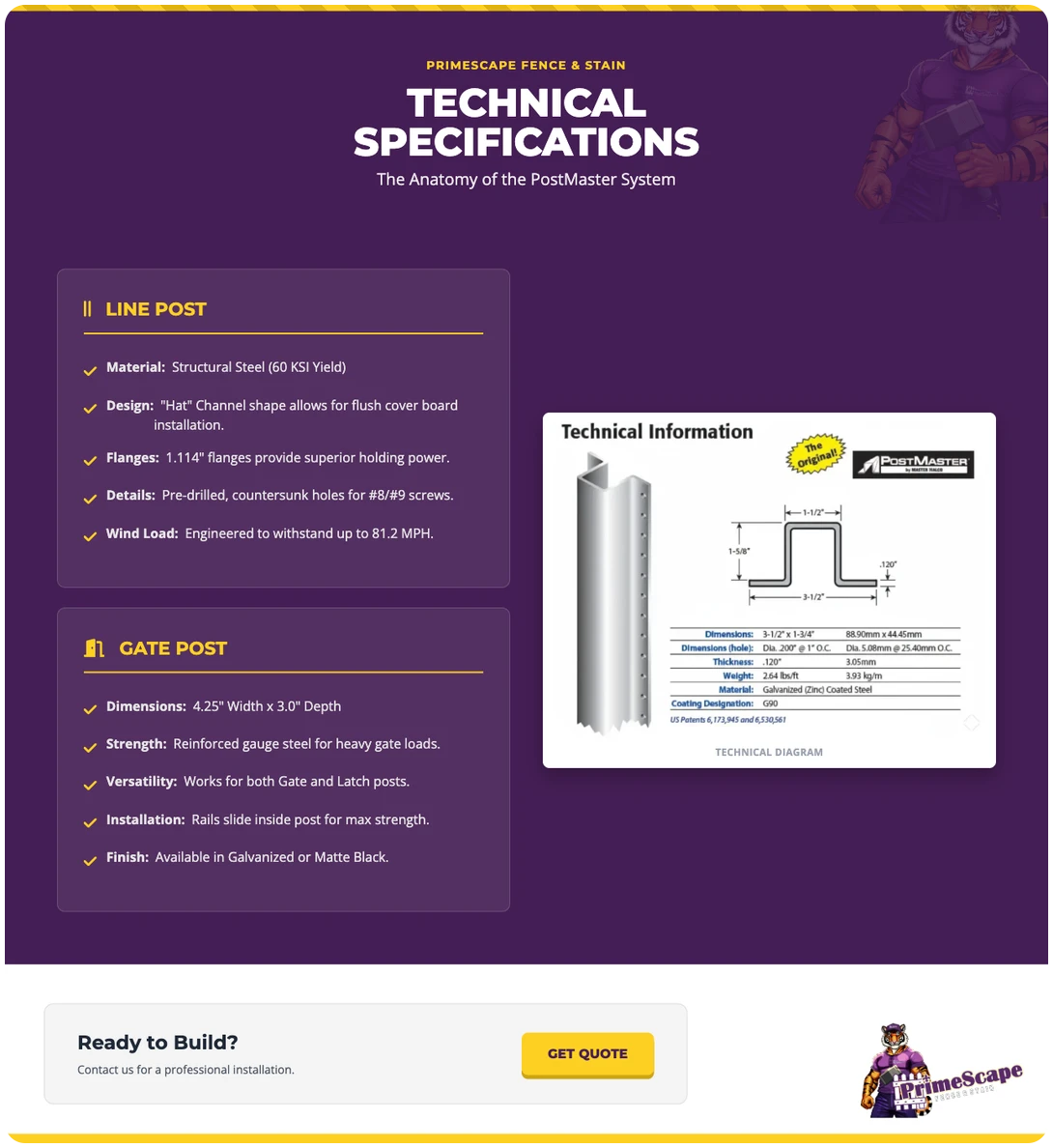
Galvanized steel does not rot. It does not get termite damage. It is not biological. The galvanized zinc coating protects the steel from corrosion for decades, and the steel itself does not provide a food source for fungi or insects.
The same factors that destroy wood posts in 8 to 15 years simply do not apply to the Postmaster post.
Postmaster’s published wind-rating data (verified by Master Halco’s installation guidelines) consistently rates the system at 110 to 130+ mph in standard configurations, depending on panel height and fence material. That is hurricane-Category-3 territory.
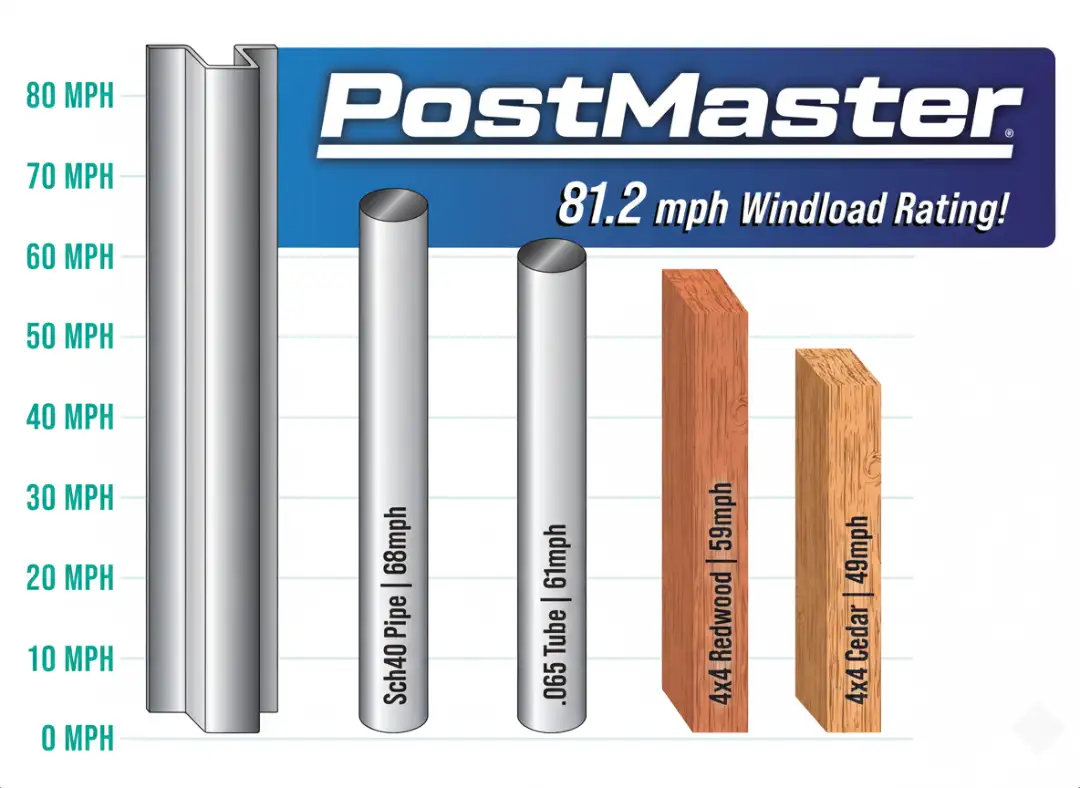
The reason is not just the steel’s tensile strength. It is the GEOMETRY of how the post connects to the panel system. Postmaster’s brackets distribute panel loads across the steel post differently than nails into a wood 4×4. The connection point is stronger, which means the failure mode shifts up the system, usually to the panels themselves rather than the post.
The ASCE 7 wind load standards document the engineering math behind structural wind resistance. Postmaster systems are designed to ASCE wind-load specifications.
The steel post does not absorb moisture. It does not expand and contract with the soil’s moisture cycles. The post stays plumb because it is dimensionally stable in a way wood cannot be in Louisiana clay.
This matters most in 5- to 10-year-old fences. Wood posts in clay drift out of true. Steel posts do not.
Conservative estimates based on Master Halco’s published data and our 15+ years of Louisiana installs:
| Post system | Lifespan in Louisiana | Failure mode |
|---|---|---|
| Pressure-treated pine 4×4 in concrete | 8-15 years | Rot at ground line, sometimes termites |
| Cedar 4×4 in concrete | 10-18 years | Rot at ground line, soil shift |
| Cypress 4×4 in concrete | 15-22 years | Rot at ground line (slower than pine), soil shift |
| Postmaster 14-gauge galvanized steel | 30-50+ years | None significant in normal Louisiana conditions |
| Galvanized steel “no-dig” driven post (other brands) | 20-30 years | Varies by gauge + galvanization quality |
The Postmaster system carries Master Halco’s manufacturer warranty (verify current terms with us at quote time). Wood posts typically carry no warranty beyond the wood treatment’s chemical efficacy period.
Not every Louisiana fence needs Postmaster. Three scenarios where the upgrade pays back fastest:
A 6-foot privacy fence presents a massive sail to wind. The taller the fence, the more leverage applied to each post during a gust. Postmaster’s wind-load advantage is most valuable on tall privacy installs in open lots, lots adjacent to lakes or fields, or hillside installs that catch prevailing wind.
Louisiana soils vary by parish. Properties in heavier clay (most of East Baton Rouge, Livingston, Ascension, Iberville) see the most ground-line shift. Sloped runs concentrate that stress at specific posts. Postmaster’s dimensional stability is most valuable in these conditions.
If you plan to stay in the home for 20+ years, the cost premium for Postmaster pays back inside 10 years by avoiding a mid-life replacement. If you are flipping the property in 3 years, traditional posts are economically defensible. The next owner inherits the eventual failure.
Some Livingston Parish neighborhoods have documented Formosan termite activity. Pressure-treated wood is not termite-proof in those zones. Steel is. If you have had termite issues in the home or neighborhood, Postmaster effectively removes wood-post-and-soil contact as a vector.
Wondering if Postmaster is right for your fence project? Call or text 225-316-2104 to walk your property with us, or request a free fence quote online. Free site visits across Livingston Parish and Greater Baton Rouge.
Postmaster posts add 15 to 25% to the total fence install cost compared to traditional pressure-treated 4×4-in-concrete. That percentage shifts based on:
| Project | Wood-in-concrete typical | Postmaster typical | Premium |
|---|---|---|---|
| 150 lin ft cedar privacy (6ft) | $5,000-7,500 | $6,000-9,000 | $1,000-1,500 (20%) |
| 200 lin ft pressure-treated pine privacy (6ft) | $4,500-6,500 | $5,500-8,000 | $1,000-1,500 (22%) |
| 100 lin ft vinyl privacy (6ft) | $6,000-9,000 | $7,000-11,000 | $1,000-2,000 (16%) |
| 300 lin ft cedar privacy (6ft) | $9,000-13,500 | $10,500-16,000 | $1,500-2,500 (17%) |
Cost ranges are typical 2026 Livingston Parish + Greater Baton Rouge numbers. Real quotes depend on site access, gate count, ground conditions, and any custom design. Get a real on-site quote before budgeting.
A homeowner who installs a wood-in-concrete fence at $7,000 today and replaces it at year 12 has spent $14,000+ (the second install costs more in 12-year-inflated dollars). A Postmaster install at $9,000 today lasts 30+ years.
The cost-per-year math:
Postmaster wins on cost-per-year in nearly every Louisiana scenario where the homeowner stays past 10 years.
The customer experience is similar but the technical details matter.
Same as wood. We walk the property, measure the run, identify gate locations and any access constraints, document any HOA or property-line considerations. We provide a written quote with separate line items for materials and labor.
Same regardless of post system. Louisiana 811 utility marks are required before any post-hole work. We handle the call.
This is where Postmaster differs. Posts can be:
We typically recommend no-dig driven for residential installs in standard Livingston Parish clay. The driven system holds equally well + saves install time + avoids concrete-cure delay.
Specialized brackets attach wood, vinyl, aluminum, or composite panels to the steel post. The brackets are part of the Postmaster system. Same overall look as a traditional fence; different structural connection.
We walk the install with the homeowner, confirm everything looks right, hand over warranty documentation. American Fence Association standards govern best practices; we are members.
Postmaster is not the only steel-post option. A few alternatives worth knowing about:
Master Halco PostMaster Plus is a heavier variant with thicker steel and higher wind ratings, designed for commercial or heavy-residential applications. Slightly more expensive than standard Postmaster.
Generic galvanized steel posts are available from various manufacturers. Quality varies widely by gauge (the steel thickness) and galvanization coating quality. Cheap steel posts can rust through faster than the wood they replaced. We do not install non-Postmaster steel posts because we cannot guarantee performance.
Concrete-only posts (precast concrete fence posts) exist but are less common in Louisiana residential. They have weight + handling drawbacks.
Composite posts (recycled plastic/wood composite) are appearing in the market. Most are not yet engineered for hurricane wind loads. We do not recommend for Louisiana yet.
For our installs, we use Postmaster as the standard upgrade option. Master Halco is the established manufacturer with documented spec sheets, real warranties, and the engineering data we need to specify confidently.
These come up most often during the first call.
From normal viewing distance, no. The steel post sits behind the panel system, hidden by the panels themselves. The post caps and visible hardware are designed to match traditional fence aesthetics. Up close you can see the steel; from across the yard you cannot.
Yes. Wood (cedar, cypress, pine), vinyl/PVC, aluminum, and composite panels all attach to Postmaster posts via specialized brackets. The post system is panel-agnostic.
Most residential installs take 1-3 days for projects under 300 linear feet. No-dig driven installs are slightly faster than concrete-set because there is no cure time before panels can attach.
Yes, and they outperform wood significantly. Wood posts in flooded ground saturate, swell, then rot. Steel posts are dimensionally stable + galvanized for corrosion resistance. After Louisiana floods, Postmaster fences are typically back in service immediately while wood-post fences need post replacement.
Master Halco offers a manufacturer warranty on the Postmaster system. Specific terms vary by configuration; verify with us at quote time. Our install workmanship is separately warranted.
Yes, typically 15-25% premium on total fence install cost. The break-even versus wood is around year 10-12; Postmaster wins on cost-per-year for any homeowner staying past that mark.
Generally no. Postmaster’s bracket system requires the posts to be installed BEFORE the panels go up. Retrofitting would mean removing existing panels, replacing posts, and reinstalling. By that point, full replacement is usually the cleaner economic decision.
Yes. Postmaster systems meet residential building codes in every Louisiana parish where we install. The International Code Council building codes recognize engineered steel post systems. Local parish codes do not restrict Postmaster use in residential fencing.
Considering Postmaster posts for your Louisiana fence?
Primescape Fence and Stain is the Master Halco authorized Postmaster installer in Livingston Parish, Denham Springs, and Greater Baton Rouge. With 100+ five-star customer reviews + American Fence Association membership, we install Postmaster systems on the majority of our residential projects because the engineering math works in Louisiana climate.
Call or text 225-316-2104 for same-day scheduling, or request a free fence quote online.