Automatic Driveway Gates in Livingston Parish: Costs and Options
July 9, 2026
Thinking about an automatic driveway gate in Livingston Parish? Here is what swing and sliding gates cost, which materials survive…
Louisiana's Leading Fence Contractor


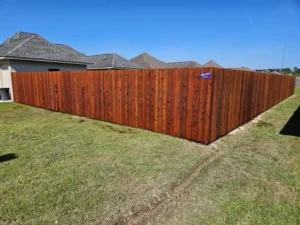

Quick Answer: In Louisiana, stain a new wood fence after it dries out for 2 to 4 weeks, then recoat every 2 to 3 years for cedar and pine. The best windows to stain are mid-spring (April to May) and early fall (September to October), when humidity and temperatures sit in the sweet spot and rain is less constant. Clean the fence each spring, inspect twice a year, and address mildew and loose hardware as they show up. Louisiana heat, UV, and humidity age a fence faster than drier climates, so a fixed schedule is what keeps it standing and looking new.
A fence in Livingston Parish takes a beating most of the year. The same sun that fades your truck fades the south face of your fence. The same humidity that warps a door swells and shrinks the boards. Add hurricane-season wind and the regular afternoon downpour, and a Louisiana fence works harder than one in a dry climate ever will.
The fix is not complicated, but it does have a clock. Stain and maintain on a schedule and a wood fence lasts 15 to 20 years looking sharp. Skip it and the same fence greys, cups, and starts rotting at the posts inside a decade.
Want your fence handled on a schedule instead of an emergency? Primescape stains, cleans, and repairs fences across Livingston Parish, Denham Springs, and Greater Baton Rouge.
Most fence guides are written for mild climates. Louisiana is not one. Four forces work on your fence year-round, and they compound.
UV and heat dry the wood and break down stain faster than a northern summer. Humidity keeps moisture in the boards, feeding mildew and the swell-and-shrink cycle that loosens fasteners and cups boards. Heavy rain drives water into any unsealed end-grain. And hurricane-season wind stresses posts and panels every year.
A fence that gets stained and checked on a schedule shrugs all of that off. One that gets ignored fails in the order you would expect: the finish goes first, then the surface greys and the boards cup, then water gets in and the rot starts at the ground line.
Here is the simple version. Each season has one or two jobs. None of them take long, and skipping them is what turns a cheap task into an expensive one.
| Season | Months | What to do |
|---|---|---|
| Spring | March to May | Clean the fence, inspect for winter damage, stain or recoat (best window) |
| Summer | June to August | Watch for mildew, rinse as needed, avoid staining in peak humidity |
| Fall | September to November | Inspect after hurricane season, second-best staining window, tighten hardware |
| Winter | December to February | Quick check after storms, clear leaves and debris from the base, plan spring work |
Spring and fall are the two windows that matter most. Both sit in the temperature and humidity range where stain cures correctly, and both come after the seasons that do the most damage. Treat them as your two appointments a year.
Recoat timing depends on the wood and the exposure. A south- or west-facing run that bakes in afternoon sun needs attention sooner than a shaded north side.
A new wood fence should dry out for 2 to 4 weeks before the first stain, so the wood can accept the finish. After that, the Louisiana recoat schedule runs roughly like this.
| Wood | Typical recoat interval (Louisiana) | Notes |
|---|---|---|
| Pressure-treated pine | 2 to 3 years | Most common and most affordable; stain protects against the swell-shrink cycle |
| Western red cedar | 2 to 3 years | Holds color well, but Louisiana UV still fades it; semi-transparent stain ages best |
| Cypress | 3 to 4 years | Naturally rot-resistant, ages slower, still benefits from sealing the end-grain |
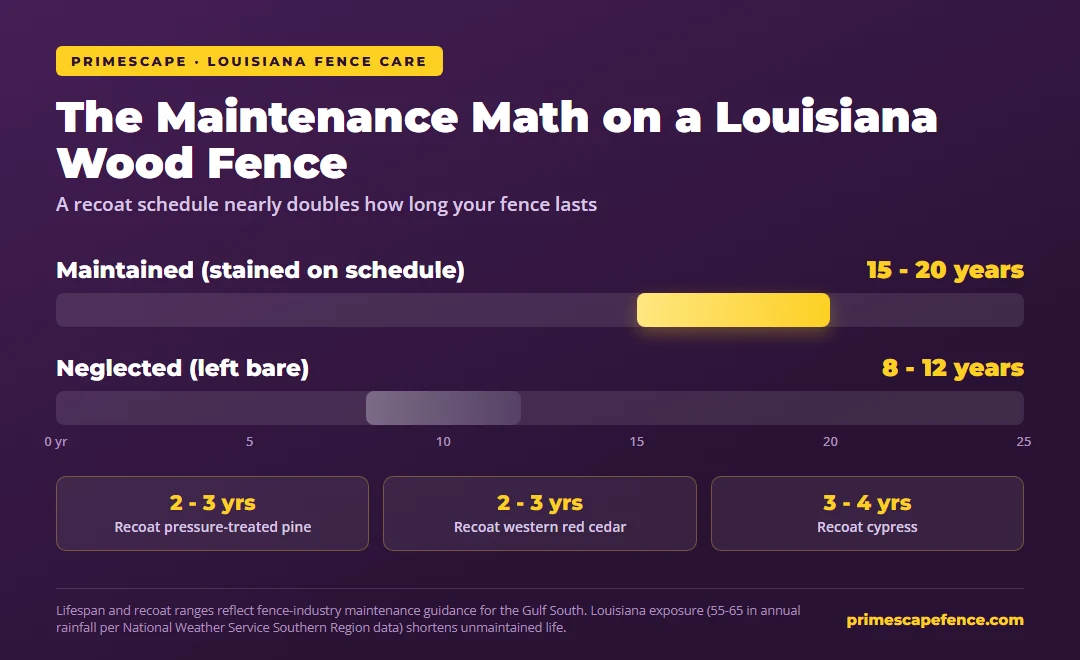
These are guidelines, not guarantees. The real test is the wood itself, which brings up the one check every Louisiana fence owner should know.
You do not have to guess. Splash a little water on the fence. If it beads up and runs off, the stain is still sealing the wood. If it soaks in and darkens the board, the finish has worn through and water is getting in. That is your signal to recoat.
Run the test on the sunniest side first, since that face wears fastest. If the south or west run fails the test, the whole fence is close, even if the shaded side still beads.
Humidity makes mildew and green algae a near-constant in our climate, especially on shaded north-facing runs and anywhere sprinklers hit. Left alone, it stains the wood and holds moisture against the boards.
A yearly cleaning handles it. A gentle wash with a fence-safe cleaner lifts mildew, dirt, and old residue so a fresh coat of stain bonds correctly. Pressure washing works but only at low pressure and the right angle, because too much pressure gouges soft wood and forces water deep into the grain. When in doubt, this is worth handing to a pro who does it without damaging the boards.
A clean fence is also the first step before any stain job. Stain over mildew and you seal the problem in.
Two inspections a year catch small problems before they become replacements. Do one in spring and one after hurricane season winds down in late fall.
Walk the line and check the posts first, since the post is where most Louisiana fences fail. Push on each one. Movement means the footing or the post base is going. Look for rot at the ground line, cupped or split boards, popped nails or loose screws, sagging gates, and any lean that was not there last season. Our fence repair and maintenance service handles the fixes that turn up, from a single rotted post to a re-hung gate.
After any named storm, add a quick walk-through. Catching a leaning post in November is a repair. Finding it after it falls in next year’s storm is a replacement.
Maintenance buys years, but every fence has a point where repair stops making sense. Knowing the line saves money in both directions.
If posts are sound and the issue is finish, a few boards, or hardware, maintain and repair. If the posts are rotting across multiple sections, the wood is cupped and splitting throughout, or the fence is past its expected life, replacement is the better dollar. A fence built on wind-rated steel posts is the version that maximizes how long maintenance keeps paying off, because the posts outlast the panels by decades.
Not sure which side of the line you are on? That is exactly what a free on-site assessment answers.
Plenty of Louisiana homeowners stain their own fence, and a small, shaded run is a reasonable weekend job. The honest tradeoffs are time, prep, and the humidity window.
The work that trips up DIY stain jobs is prep and timing: cleaning correctly, letting the wood dry to the right moisture level, and catching a 2-day dry window in a humid climate. Get those wrong and the stain peels within a year. For a large fence, a privacy run in full sun, or a property you are getting ready to sell, our fence staining and painting service handles the prep, the timing, and the even coat that actually lasts.
Fence due for a recoat or a tune-up? Get on the schedule across Livingston Parish, Denham Springs, and the Greater Baton Rouge metro.
Not every fence gets stained, but every fence gets maintained. The non-wood materials skip the recoat and still need a yearly look.
Vinyl and PVC need a yearly wash to clear mildew and keep the white from going dingy, plus a hardware check on the gates. Aluminum is close to maintenance-free but benefits from a rinse and a check for any chipped powder coat that could start corrosion. Chain link wants a look at the tension, the fittings, and any rust starting at the line posts. All three still take wind stress every storm season, so the post-and-gate check still applies.
These are the questions Livingston Parish and Baton Rouge homeowners ask us about keeping a fence in shape.
Mid-spring (April to May) and early fall (September to October). Both sit in the temperature and humidity range where stain cures correctly, and you have a better shot at a dry stretch. Avoid peak summer humidity, which slows curing, and hard-freeze spells in winter.
Every 2 to 3 years for pressure-treated pine and cedar, and every 3 to 4 years for cypress. Louisiana UV and humidity push these to the shorter end versus drier climates. The water-drop test is the real answer: when water soaks in instead of beading, recoat.
Yes, but not right away. Let new wood dry out for 2 to 4 weeks so it can accept the finish, then stain. Sealing the wood early protects it from the swell-and-shrink cycle and the UV that age an unfinished Louisiana fence fast.
You can, at low pressure and the right angle. Too much pressure gouges soft wood and drives water deep into the grain, which delays staining and damages the boards. A gentle wash with a fence-safe cleaner is safer, and the fence has to dry fully before any stain goes on.
A wash with a fence-safe cleaner lifts most mildew and algae, which thrive in Louisiana humidity on shaded and sprinkler-hit runs. Clean it before it stains the wood or holds moisture against the boards, and always clean before restaining so the new coat bonds.
A semi-transparent stain is the best all-around choice here because it adds UV protection and color while still letting the wood breathe. A clear sealer protects against water but gives up almost no UV defense, so it fades faster in our sun. Solid stains last longest on color but hide the wood grain.
Keep your fence looking new without the guesswork.
Primescape stains, cleans, inspects, and repairs fences across Livingston Parish, Denham Springs, and Greater Baton Rouge. We handle the prep, the timing, and the even coat that holds up to Louisiana sun and humidity. With 100+ five-star reviews, we treat your fence like it is built to last, because we built it that way.